

Vietnam’s steel industry is entering a very important transition period. “Greening” the production process is now no longer a goodwill option, but has become a strategic imperative that determines the existence and sustainable development of the entire industry on the global trade map.
A large position comes with high emission intensity
From 2015 to now, Vietnam’s steel industry has made breakthroughs, rising to the position of the world’s 13th crude steel producer and leading the ASEAN region in both production and consumption of finished steel products. However, this brilliant development is bringing great environmental consequences.
Globally, the steel industry accounts for about 8% of total CO2 emissions. In Vietnam, this picture is no less stressful when the steel industry is responsible for 7-9% of total national emissions and accounts for up to 45% of industrial processes. Specifically, in 2023, the industry’s emissions are estimated to reach 32 million tons of CO2, and there is a risk of reaching nearly 40 million tons in the coming years if it continues to scale up. The core cause of this situation comes from the fact that this heavy industry is too dependent on blast furnace technology (BF-BOF) using coke, which has a very high carbon emission intensity.
Pliers from carbon mechanisms
Transformation pressures are besimuring businesses from both sides: export markets and domestic policies.
- Resistance from CBAM: The Carbon Border Adjustment Mechanism (CBAM) initiated by the European Union (EU) has started the pilot phase from October 1, 2023 and is expected to be fully implemented by 2026. Iron and steel are the most affected commodities, accounting for 56% of the value of goods covered by CBAM. Currently, the emission intensity of Vietnamese steel is at 1.36 tCO2/ton, 24% higher than the EU’s 1.1 tCO2/ton. Preliminary estimates indicate that the cost of CBAM can account for 15-20% of the cost of exported steel products. If there are no measures to improve, Vietnamese steel will lose its competitive advantage, even losing market share in the EU.
- Domestic carbon market: From 2025, Vietnam will pilot a carbon market, in which steel is one of the three key sectors along with thermal power and cement. Businesses will be forced to comply with emission limits, and if they exceed them, they will have to pay additional costs to buy carbon credits in the market.
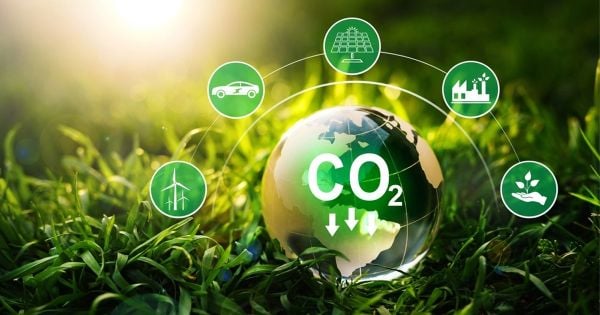
The picture of Vietnam’s steel industry under the pressure of “greening”: Survival challenges and opportunities for transformation.
Barriers on the journey of “decarbonization”
Despite being well aware of the urgency of green transformation, Vietnam’s steel industry is still facing a series of challenges:
- Huge investment costs: Replacing blast furnace complexes with direct reconstituted iron technology using hydrogen (DRI) or carbon capture systems (CCUS) requires billions of dollars in capital. This is an overwhelming problem for many small and medium-sized businesses.
- Lock-in effect: The close attachment to traditional blast furnace technology makes it extremely difficult both technically and economically to abandon invested assets to move to a new technology route.
- Gaps in the MRV system: The majority of Vietnamese enterprises have not established an international standard measurement, reporting and verification (MRV) system. This leads to the use of European defaults, which often overestimate actual emissions. causing great disadvantages to exporters.
- Shortage of human resources: The industry is facing a severe shortage of highly qualified engineers and workers capable of operating advanced green steel production technologies.
Technology roadmaps and solutions to shape the future
To relieve pressure and move towards the goal of Net Zero emissions by 2050, the steel industry needs a specific roadmap, divided into 3 stages:
- Phase 1 (To 2030 – Optimize): Prioritize solutions that are low-cost and deliver results quickly. Focus activities include the implementation of the Minimum Energy Efficiency Standard (MEPS) and the application of residual heat and gas recovery technology for power generation.
- Phase 2 (2030-2040 – Transition): Pilot implementation of carbon capture technology (CCUS) in large complexes. At the same time, new investment in modern electric arc furnace (EAF) technology using renewable energy is encouraged and hydrogen application research is promoted.
- Phase 3 (2040-2050 – Breakthrough): Widely commercialize the technology of direct reconstituted iron production with green hydrogen (DRI-H2) and proceed to completely replace blast furnaces that have reached the end of their life cycle.
Besides the technological factor, the most potential and urgent direction is to develop a circular supply chain, especially to promote the scrap recycling industry. The increased production of steel from scrap using electric arc furnace (EAF) brings a lot lower emissions than traditional iron ore steelmaking.
Green transformation cannot be a lone battle for businesses. To succeed, it is necessary to have the cooperation of the Government through accelerating the operation of the emission trading market (ETS), establishing the Green Transformation Support Fund, as well as promulgating preferential policies on finance, taxes and green public procurement. Despite the short-term pressures on costs, the process of “greening” is a long-term opportunity for Vietnam’s steel industry to enter an era of modern, competitive and circular development.
See some chemicals for the steel industry here: https://dk-chemicals.vn/
See some of our other products here: https://dk-metalsurfacetreatment.com/san-pham-cong-ty-tnhh-hoa-chat-d-k/